JUMP

Jump vimeo from Beth Peloff on Vimeo.

Hello, Fellow Music Fans. It’s time for Show and Tell!

A while ago, I participated in the MNkino Film Score Fest 2017 and had the opportunity to work with a wonderful Individual, Beth Peloff of Green Jeans Media. After the successful premiere of “Blobs Adventure” in July,  we spent a lot of time trying to get together to celebrate this fact.

Fast forward to December.: After a bit of a creative rut on my end, and lots of reasons involving life happening, Beth and I finally reunited. When I discussed my problem with her, she offered to send me a short film she had worked on to give me a worthwhile (and fun) project to focus on.

This is the finished product. I hope you enjoy!

What I took away from Composition Intensive

Recently, I had the magnificent opportunity to attend the St. Mary’s 2 week long composition Intensive, and boy was it Intense. It was a fantastic experience overall, and I got to learn from the likes of Zae Munn, Michael Schelle, Kristin Kuster, Jay Batzner, David Murray, and Joshua Marquez as well as the 16 other talented composers who attended (see the bottom of the page for links to some of their pages) and even participated in most of the masterclasses offered. As describing the experience could get extremely jumbled, I have decided to provide a basic list of what I was reminded of and remember learning in the two week session.

Most of the St .Marys group
Most of the St. Mary’s group. Top Left to right: Samantha Hogan, Zae Munn,Cody Kahul, Evan Jay Williams, Daniel Ang, Sakari Dixon Middle: Tori Orvil, Robin McLaughlin, Lam Khoa, Jay Batzner Bottom: Gil Dori, Jeffery Nicholas, Joshua Marquez

1) The World is much bigger than we realize. Sometimes it’s easy to get caught up in the protective bubble of where we are used to (for example the university). However there is so much more to do as well as territory to explore in the world composition than I was previously aware of.

2) The World is much smaller than we realize. Case in point, some professors knew my teachers as well as the other participant’s teachers. Also, some of the participants knew each other from attending other composition festivals.

3) Lugubrious is a fantastic word and is not only used by YSU’s trombone studio, but by fellow composers as well!

Composers at work
Composers at work

4) How to network better.

5) Things I should be doing that I wasn’t doing before concerning advancement toward my desired career: Entering more contests, applying for residencies and attending more festivals, and researching certain grad programs that I was not sure of where to look before. Also, I need to be recording my pieces more often. The suggestion to contact the music ed department to ask for placement to get experience working with students and teachers in clinician type settings was also suggested for me to try (Thanks Robin!).

6) How to go about the things I wasn’t doing before.

St Marys 2014 Site specific
A Site Specific Piece, “The Island” by Lam Khoa being performed at a masterclass.

7)From Michael Schelle: You can still be your- (eclectic, unconventional, cat loving) self and still be a successful composer(Yes,there is hope for everybody who really wants this) what a site specific piece is, and new methods to include extra musical influences in my music like theater for example. Also, don’t trust the Dining Hall’s grilled cheese.

8) From Kristen Kuster: How to interact with an audience professionally and in a way to avoid boring them when you talk about your piece. This was needed as my experience talking in front of large groups is limited at this point and I can use this. In accordance with her valuable suggestion, I am going to try laying out my pieces horizontally in a time line format to get a better sense of what I am doing as far as building up pieces and refining their form.

9)From Jay Batzner: It’s ok to focus on writing for young groups as a composer (even needed) and that I am going in the right direction with the piece I brought in for our lesson (Reverence). Moreover, I was enlightened in the ways of electronic composition and how to go about trying this cheaply. The possibilities excite me and I cant wait to get started on exploring this “new” world.

St Marys 2014
Michael Schelle Master Class        Pictured: Nathan Brown, Lam Khoa, Samantha Hogan, Michael Schelle and Robin McLaughlin (piano)


10)From Zae Munn: “The Big Permission slip” solves any doubt about what you “shouldn’t” do in composition. Also, the lesson she gave me provided a better understanding of how to use text to shape a composition and how to set text.

11)From Joshua Marquez: He introduced me to the “over bowing triangle marking” and I’ll probably use it the next time I attempt to write a string piece. Additionally, he showed me how to better use Audacity to clean up audio.

12)From David Murray: A thorough understanding of how string instruments work. Also, he is a beast at sight reading! His recording of the techniques I attempted to employ in the bass piece sketch will serve me well in a future piece.

13) Squirrels can make Kicka** mascots. Ours was eventually named Cheeeeezy when Whiticre Whiskers and Berkowicz was eliminated.

10460760_277018402487034_3830138443028692696_n

14) Most importantly, I learned that I  have a fair shot at getting to do what I want  as a career for the rest of my life and that it is not a mistake to chase my dream. Additionally, I should and will keep playing my horn (thank you for the encouragement everybody) as it is important for a composer to keep a musical and personal connection to the performing world and I am not the only one to hold that view. (Also,unexpectedly performing  for nuns is fun and oddly satisfying).In the mean time though, it’s Bach to composing to hone my craft, and working on life one step at a time.

Here are some  links to my new friends and future colleagues sites/sound cloud pages. Please check them out as there is a large variety of music to explore composed by some talented people who are certain to go far.

Adam O’Dell     Robin McLaughlin     Jeffery Nicholas    Sakari Dixon

Andre Codeco    Kevin Wilt     Tori Ovel     Nathan Brown


My Latest Expirament

Thanks to my composition inquisitor (aka teacher), I have been working on a piece completely unlike any other I have attempted as of yet. Scott challenged me to  abandon my usual frame of having a story to compose  and instead  write what is called a Visual-Spacial notation piece. Basically the piece does not have bar lines to designate strict meter subdivisions. Instead, it leaves it up to the performers to designate where the musical figure is to fit within where the designated time specifies. It calls for ordered improvisation with a demand for the group to play as an ensemble.  So far, the piece looks like this:

(Click picture for a larger view)

Composing this piece has forced me to think more freely about musical lines and textures and to consider multiple possibilities for the building blocks of a work.  Along the way, my teacher has had me looking at various scores with non-traditional notation by Cage, Varese and others I may not have picked up otherwise and we have discussed them in our lesson. Many Cagian  ideas such as indeterminacy have made it into this piece as a result. For example, I got the idea for how to break up the time by rolling dice except for the 30 second section, where I anticipate the performer to successfully make a sandwich with the ingredients already set (mainly because I timed this myself at home).

Other than the fact that I am using kitchen percussion and adding the humorous element of a musician making a sandwich for no other reason than to add improvised non- traditional sounds, this piece lacks a preconceived story and instead has its own underlying framework. Although I anticipate that the piece will sound “wonkey” if and when it is performed, I have enjoyed trying to think within this loose structure.

Highlights from the Last Month

So, it’s been awhile since I have had time to post anything on here. 1 month in Internet time is equivalent to “like forever” in real world time as we all know. In order to make up for that time, I will attempt to explain the highlights  in a nutshell:

1) Cumulus Humilis was performed 3 times by Avguste Antonov the week of the New Music concerts at the end October. In that time, he was approached by Hartshorn record company in NY to record a cd of New piano works. To make a long story short (too late) he chose my piece to record on the Cd and I am still ecstatic!!!

2)New Pieces have been written- As an added unexpected feather in my cap, I was asked to write music for the upcoming Worlds Quest browser game. This was my first official video game related project and I am elated to say that my first attempt was a success .To sum things up, they liked it-a lot and I am grateful. The game will be released  on December 20th.

Also, I have been working on a new experiment at the request of Scott. I will be writing a blog post about it shortly. Other plans include creating a  collection of one page solos for  from all of the 8 bar excerpts that were composed for Instrumentation class this semester. I am debating calling the collection Doodles and Scribbles or something to that effect.

Desiree Carrion and I after Carols and Cocoa 2013

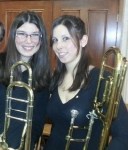
3) I played my last Carols and Coccoa concert of my undergrad. This was a surreal experience as it is hard to believe that the time has flown that quickly. Kudos to my friend (and soon to be SAI sister) Desiree Carrion for having her first arrangement for Trombone ensemble performed. God Rest Ye Marry Trombonists was a ball to perform for a last hurrah ,and I especially cracked up singing the Lyrics “to save us all from Schoenberg’s Music when we’ve gone astray”. For a three hour plus long annual concert that we all complain about, I’m sure going to miss performing in it-sort of.

4) In November, I helped premier  a piece for Trombone quartet by fellow composer Richard Zacharias called Pardon My Slide with my friends Mariah Bailey, Bo Violette and Andrew Stamp. I also had the honor of Performing The Dance of Spring for Yanda Zhu’s Graduate Composition Recital. If you haven’t heard of him, you probably will soon.

My Top 10 Composers

*Disclaimer: This list tends to fluctuate on an almost a weekly basis as there are numerous composers that I admire and respect. The composers that have made this current list are the ones that end up on this list most often when someone asks me this question and are in no particular order of ranking .  When you reach the bottom, I encourage you to comment on some of your favorite composers and add to the discussion. That being said, lets get on with it.

#10: Gustav Holst

Who are they: An English composer responsible for the first original concert band piece  (Suite in Eb)and composer of The Planets among other fantastic works.

Why is he/she a favorite: He wrote some of the first band music, my favorite large scale orchestral piece (The Planets) and was also a trombone player. His story of how hard he worked in his lifetime by teaching himself to compose, deal with  having a weak constitution, and teaching many, I find inspiring. Also,I love his sense of melody and use of folk tunes in his works.

#9 Joe Hisaishi

Who are they: The composer behind much of the wonderful music in Hayao Miyazaki’s films. For Example: My Neighbor Totoro, Spirited Away, Howls Moving Castle, and Princess Mononoke.

Why is he/she a favorite: Many of his melodies are breathtakingly beautiful. I was first exposed to his music when watching anime such as My Neighbor Totoro, Spirited away, and Howls Moving Castle. When I saw him playing the piano AND conducting his own pieces simultaneously thanks to you tube, he instantly became one of my favorite living composers. He not only writes notes, but knows how to make music as well.

#8 Igor Stravinsky

Who are they: The composer responsible for the alleged May 29th, 1913 riot. It was all his fault for composing The Rite of Spring.

Why is he/she a favorite: I am a sucker for rhythm and rhythmic gestures. That being said, Stravinsky’s music captures my attention in a way that most music evades. I can also appreciate how he as a composer evolved from his early Firebird Suite days and developed a distinct voice that is heard in his ballets Petrushka and The Rite of Spring and in  Histoire du soldat . Incidentally, he was also one of Frank Zappa’s favorites as well.

#7 Koji Kondo/ Junko Tamiya/Hirokazu Tanaka

Who are they: Composers behind the music for various Nintendo and Capcom Titles. To name a few: Mario Bros., The Legend of Zelda (Kondo), Bionic Commando, Little Nemo, The Dream Master (Tamiya), Metroid and Super Mario Land (Tanaka).

Why is he/she a favorite:  Having grown up in the era of the Nintendo Entertainment System, I was exposed to the 8 bit music of these games on a regular basis . Composers for these games had to be extra creative because they had a much more limited sound palate and range  to work with and had to create music that looped indefinitely. Although the  midi “instruments” sounded like beeps and boops (which probably helped earn  its passe reputation with more “serious” music critics) some of these melodies are surprisingly harmonically complex.  Kondo and Tamiya and Tanaka   are grouped together because it was their music that I was first inspired to pluck out on the piano  Many of my earlier compositions (and some recent) echo their influence.

#6 John Mackey

Who are they: Self made composer known for writing lively pieces with lots of percussion and ostinatos.

Why is he/she a favorite:  Did I mention I love Rhythm?  Also, his blog is a bowl of fun to read and he has an adorable cat. Musically speaking, I remember playing “Strange Humors” for the first time in All College Band and thinking “Woah!,  You can use Djembe in a band piece? And, I’m really allowed to gliss on my trombone? So this is what modern  band music sounds like.” Besides the fact that I enjoy his compositions, I admire him for the fact that he has literally made composing music his day job and does both the creative and business sides of music himself.

#5 Claude Debussy

Who are they: French composer labeled as an impressionist, although he probably would have disagreed with that label, according to a music history professor of mine. he Wrote the infamous Clair De Lune and  Prélude à l’après-midi d’un faune.

Why is he/she a favorite:Because he dared to be different and not follow the conventions of Western music that he grew up with and still made beautiful music. The colors and scales he uses in his music are what draw me to it.

#4 Frank Zappa

Who are they:Composer known for his sensational stage antics, complex rock, Jazz, Classical and everything in between, and knowing everybody.

Why is he/she a favorite: Yes, I know that many people look at Frank Zappa the person and are instantly turned off by the absurdities or look at some of the vulgarities in his lyric content and are too disgusted to consider listening to the music. Just as many are probably intrigued. Personally, I try to ignore this when applicable and try to focus on the music only. That being said, he was very eclectic and resourceful, drawing on several influences, sound palates and styles. This is  a strategy I try to emulate with my own music but in my own way. Many are also unaware that he wrote classical music as well. The  style transitions in his music are also genius.Fun fact: Although he is no doubt eccentric, he did not support drug use and was relatively clean, aside from liking his Smoke and drink.

#3 George Gershwin

Who are they: A composer who successfully fused American Jazz, Tin Pan Alley and Classical and is known for Rhapsody in Blue, Porgy and Bess and An American in Paris.

Why is he/she a favorite: This man’s music is Fun to listen to. I’ve Got Rhythm, Swanee, and the tune from Rhapsody in Blue all got stuck in my head at one time or another and, unlike most ear worms, I was OK with it. Also, although I did not list any more jazz composers on this particular list, Jazz  is a genre that I enjoy listening to and it is interesting to hear the obvious influence in his music.

#2 Ralph Vaughn Williams

Who are they: An English composer who was a friend to Gustav Holst and wrote some gorgeous orchestral music in my humble opinion.

Why is he/she a favorite:  Three words: The Lark Ascending.

#1 Me…….Just Kidding

The actual # 1 is Bela Bartok

Who are they:Hungarian Composer who gathered Folk melodies, wrote pieces for students and professionals alike.

Why is he/she a favorite: As an avid lover of Folk influence in music, he is a composer up my ally. Plus, in theory classes, I sincerely enjoyed analyzing his music. It was fun to see how much thought was put into his music and it still sounds musical to me. Unlike many other pieces that I have studied, his have always been like putting a rewarding  jigsaw puzzle together. After doing the academic work to find the visual pattern on the page, the resulting sound “picture” was not torture to the ear, even with the amount of sophistication in the pieces studied. Also as a teacher, he knew how to write music that was geared towards teaching students that was also not corny (like many tunes in student level books) to listen to when playing through it. On top of that, his last name is just plain cool;cool enough for the white bat in Anastasia to share the same name.

Help to get your Creative Juices Flowing Again (composition edition)

Anyone who has done  a large amount of composing knows that  from time to time,  a creative rut can occur. But have hope. These mental blocks can’t last forever and there is help out there. Here is  a list of ideas to help with getting rid of writers block that I’ve learned over the years from others as well as from personal experience.

1) Pick an instrument and give yourself a time limit to compose (I usually do 45 minutes to an hour). After the time is up, do not touch the piece for the rest of the day. Repeat several days in a row with a new piece each time.

The best thing about this exercise is that, though whatever comes out of the session may not be a masterpiece, it gets you in the habit of writing every day and may even help you develop a more efficient way of writing down ideas and coming up with them quicker. Also you can always take fragments of these bits later and use them in a larger work. Many thanks goes to fellow composer Dan Brandt for showing me this exercise.

2) Read a book and envision a movie score.

This works best with Fiction Novels. As an example, Of Wizards and Dragons is inspired by events of the first book in The Enchanted Forest Chronicles.

3) Get a list of random subjects and pick them out of a hat.

Whatever you pick is the subject for your next work. (similarly, you can do this by putting instruments into a hat and repeating the same process) Here is a list to help you get started.

4)Step away from the Music and give your mind a break.
Sometimes doing something non-musical like taking a walk or attending a scientific lecture  can inspire in unexpected ways. When I studied with Dr. Gwen Rollin, she recounted how her former  composition teacher, Iannis Xenakis, once required his students to drive a long way to a lecture about celestial bodies. His justification : inspiration for a piece can come from any source and educating the mind is always beneficial.

5)Ask a musician friend for an assignment

…or what it is they want to hear for their instrument and write it for them. Bonus: There is a greater chance that your piece will be performed.

6)Pick 3 instruments/ styles that you have not written for yet and write a trio.

You can also apply this exercise to time signatures and voices you have not used yet in a piece.

7) Reverse your Process

If you are used to writing the melody first and then the accompaniment, try writing the accompaniment first next time. Or, vice-verse.

8)Pick 5 notes at random

This is your melody. You can further challenge yourself by allowing these to be the only pitches allowed in the piece.

9) Mirror Image

At a keyboard,  pick two pitches, preferably at least an octave apart. When one pitch goes up a third, the other pitch goes down a third for example. Try playing with various combinations. I have “accidentally” come up with germ  melodies and harmonies this way.

10) Close your eyes and don’t look at what you play.

Let your musical ear and creative heart be the only things that guide you. Don’t forget to record yourself in the process.

Most importantly, remember to Always Be Open, as anything may prove to be an inspiration for a piece.

If my fellow composers have any other suggestions to add to this list, please leave them in the comments below. And as always, Happy Composing!